


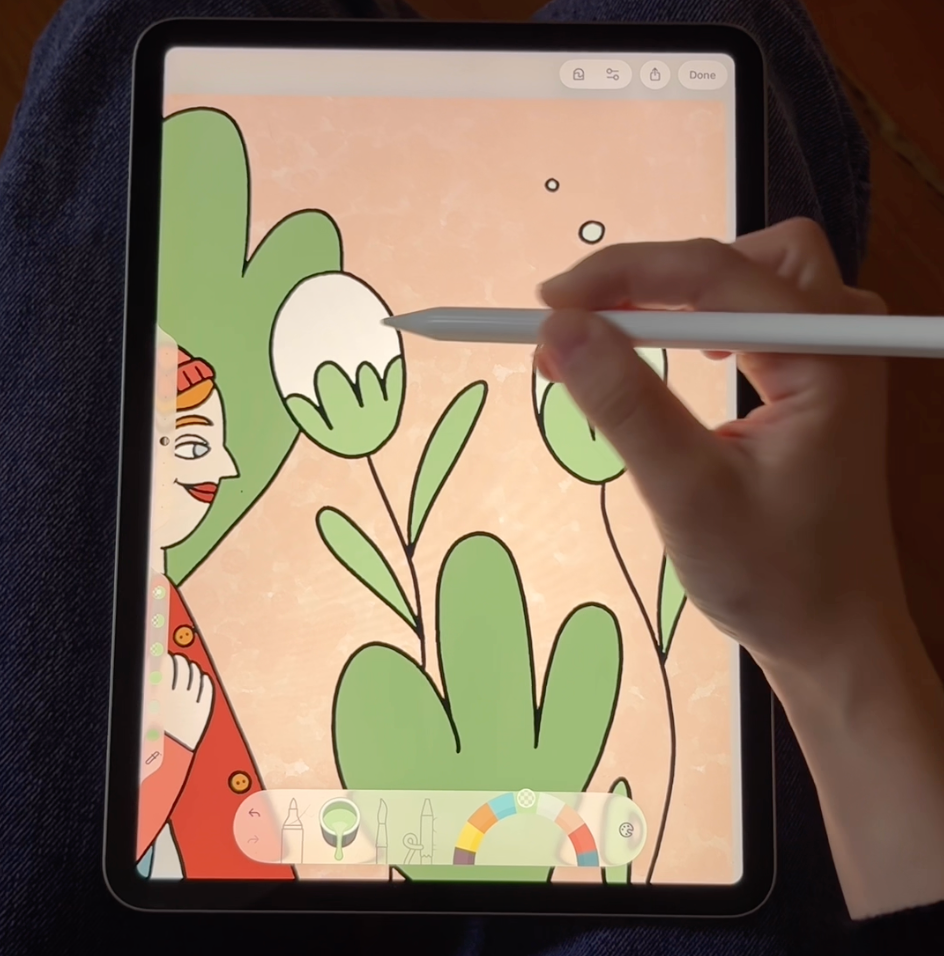
You know that oddly satisfying feeling of watching a coloring video where every brushstroke has its own soft little sound? It's called ASMR coloring, and it's part of the reason Lake sounds the way it does.
Turn the sound on in Lake and you'll hear it immediately: each brush has its own gentle sound as it moves across the page, mimicking what it would actually sound like on real paper. It's a small detail, but it's the same thing behind all those "tingles" comments on TikTok coloring videos - sound designed to make an already-relaxing activity feel even more soothing.
What does ASMR even mean?
ASMR stands for "autonomous sensory meridian response", which is a very clinical way of describing a very simple thing: that tingly, relaxed feeling some people get from certain sounds or sights. Whispering, tapping, soft scratching, pages turning. If you've ever felt oddly calm watching someone fold towels in a video, you already know the feeling, even if you didn't know it had a name.
Not everyone feels it, and that's completely normal - some people get the tingles, some just find the sounds pleasant background noise, and some don't notice a difference either way. All three reactions are fine.
In short: ASMR coloring is coloring paired with soft, responsive sound, usually brush or tapping sounds, designed to make an already-relaxing activity feel even more calming.
So what makes coloring "ASMR coloring" specifically?
It's coloring with sound added right into it. Some people search out ASMR coloring videos just to watch. But the more interesting version is when it's built right into the app you're already coloring in, so the sound reacts to what you're actually doing, stroke by stroke, instead of playing separately in the background.
That's what's behind Lake's coloring sounds: sound design that mimics the feeling of real brushes on paper, the soft drag of a watercolor brush, the little scratch of a pencil-style tool. It's not music, and it's not a voiceover. It's closer to the ambient sound you'd hear if you were actually coloring at a table, just gentler and more deliberate, playing as you use different brushes on the canvas.
That's what's behind Lake's coloring sounds: sound design that mimics the feeling of real brushes on paper, the soft drag of a watercolor brush, the little scratch of a pencil-style tool. It's not music, and it's not a voiceover — it's closer to the ambient sound you'd hear if you were actually coloring at a table, just gentler and more deliberate, playing as you use different brushes on the canvas.
Coloring in the Lake app with the ASMR brush, featuring calming sounds.
What makes Lake's ASMR sound design work
A few things went into it, and they're worth knowing if you're curious why it feels the way it does:
- It's optional, not forced. You can turn it on or off whenever you want - it's a toggle in Settings, not a default you're stuck with.
- The sound actually responds to what you're doing, stroke by stroke, instead of just looping underneath regardless of your movements.
- There's variety - different brushes sound different, rather than one sound on repeat no matter what tool you're using.
- It works well with headphones, since a lot of people use it specifically to wind down before bed.
If you're curious what else comes with Lake beyond the relaxing ASMR sounds, our guide to what's included in the free version covers the rest of the features.
It's a small feature, but it adds up
None of this is complicated. It's a sound layer on top of something people already found relaxing. But that's kind of the point of ASMR as a whole: small, specific sensory details that don't do much on their own but add up to something that genuinely helps some people unwind. If you've been curious what all those satisfying coloring videos on your For You page are actually about, now you know. And if you want to try it for yourself instead of just watching it, Lake's coloring sounds are one tap away in Settings.
FAQ
Is ASMR coloring different from a regular coloring app? Not really, it's a regular coloring app or coloring session with sound added on top. The coloring itself works the same way; the difference is whether there's ambient or brush sound layered in as you color.
Do I need headphones for ASMR coloring? No, but a lot of people prefer them. Headphones make the sound feel closer and more immersive, which is part of why ASMR content in general is often watched or used with headphones in.
Why don't I feel anything from ASMR sounds? That's normal. ASMR affects people differently: some feel a strong tingling response, some just find it calming background sound, and some don't notice much of a difference. None of those reactions mean you're "doing it wrong."
Can I turn ASMR sounds off if I don't like them? In a well-designed app, yes, it should be a toggle you control, not something you're stuck with permanently. Lake's coloring sounds work this way: on if you want them, off if you'd rather color in silence or with your own music.
Why do coloring apps add sound at all? Mostly because coloring is already a sensory, hands-on activity, and sound is a natural extra layer. The goal isn't to distract you but to make the experience feel a little more tactile and immersive, closer to how it would feel with real brushes and paper.