



Recently, almost every conversation I have - whether it's with friends, colleagues, or even acquaintances - touches on the delicate subject of sleep. Or more accurately: sleeping issues. I'm not immune to that either. I've had my fair share of nights staring at the ceiling, wondering why my brain refuses to cooperate when the rest of me is exhausted. And I know I'm not alone. Studies show that nearly 1 in 3 adults regularly struggle with sleep, whether it's falling asleep, staying asleep, or waking up feeling oh-so-very tired.
What surprises me is how normalized this has become. Sleep deprivation used to be something people mentioned reluctantly, almost embarrassed by it. Now it's small talk. We compare notes on useful techniques and helpful items like we're trading recipes. That alone should tell us something about how widespread - and how serious❗️ this problem really is.
The moment the lights go off
For me, the problem usually started the moment I got into bed. I'd turn off the light, close my eyes - and my brain would instantly light up. Tasks I hadn't finished. Random worries. Creative ideas that just wouldn't wait until morning. It felt impossible to switch off 😬
I've since learned there's actually a name for this: cognitive arousal. Your nervous system stays in a kind of low-grade alert mode, running through unresolved thoughts like a browser with too many tabs open. The bed becomes a trigger rather than a cue for rest, because you've trained your brain to associate it with thinking instead of sleeping.
Knowing that didn't immediately fix anything, but it helped me stop blaming myself and start thinking about what I could actually change.
The reading habit. And its limits.
Most nights, I like to read before bed. I truly enjoy it, and it genuinely works for winding down. There's something about following someone else's thoughts - rather than spinning in your own - that naturally quiets the mental noise. A good book creates just enough cognitive engagement to give your brain something to do without overstimulating it.
But some evenings, I'm simply too tired to focus. And in those moments, like many of us, I reached for my phone. Just a quick scroll to distract my mind… which inevitably turned into a full hour of doomscrolling.
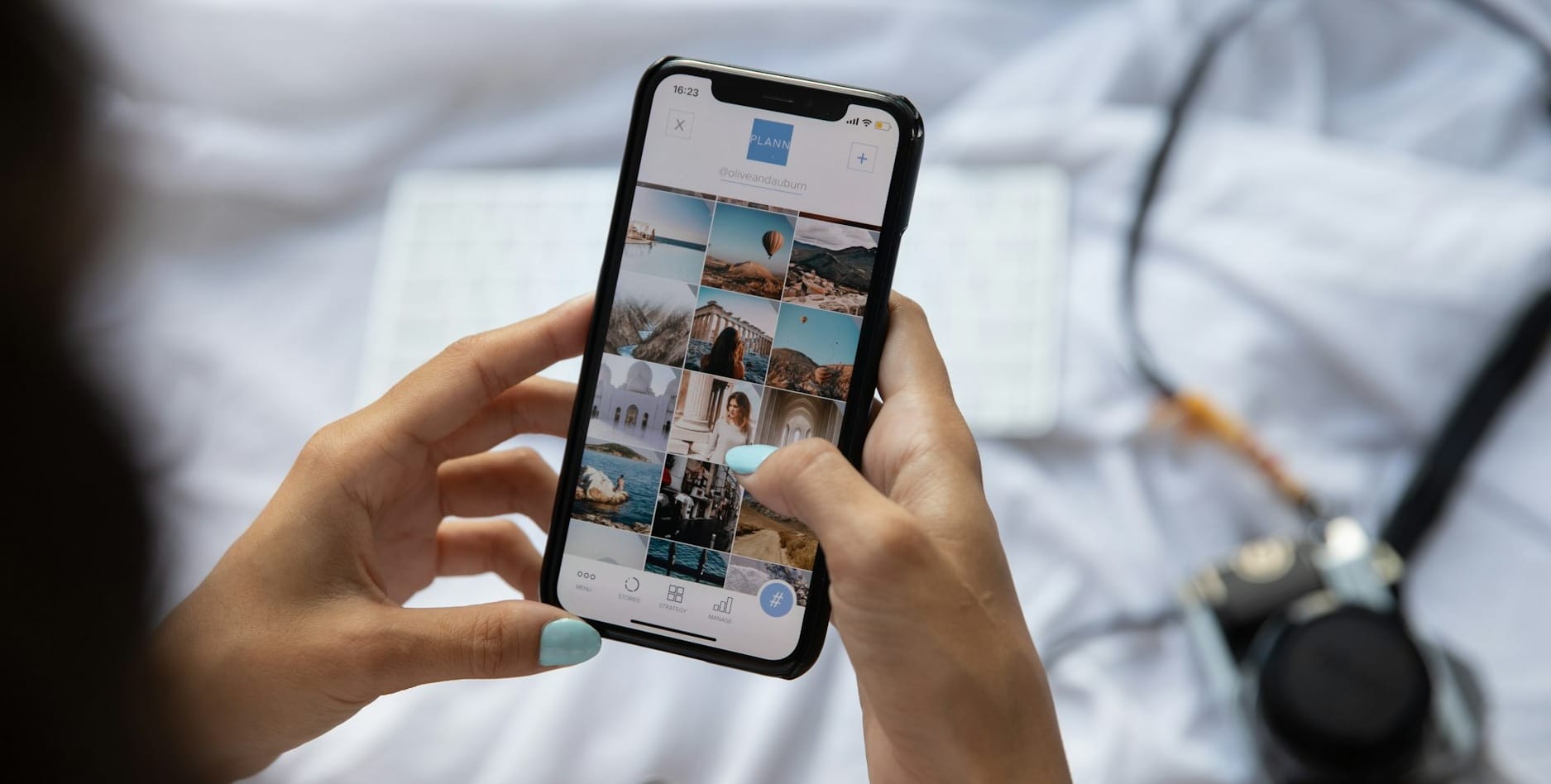
Did it help me fall asleep? Hell no.
The thing is, I don't think the problem is the screen itself - it's what you do on it. Scrolling social media is specifically designed to be unpredictable: you never know what the next post will be, and that unpredictability is exactly what keeps the brain alert. The fast-paced content, the emotional triggers, the endless little dopamine hits… all of it sends a signal to your nervous system that says stay awake, something important might happen. Winding down becomes almost impossible.
Finding my own way - through my own app
Here's where it gets a little funny: I'm a cofounder of Lake, a digital coloring app. We built it with relaxation in mind. And yet it took me an embarrassingly long time to start using it as part of my own bedtime routine.
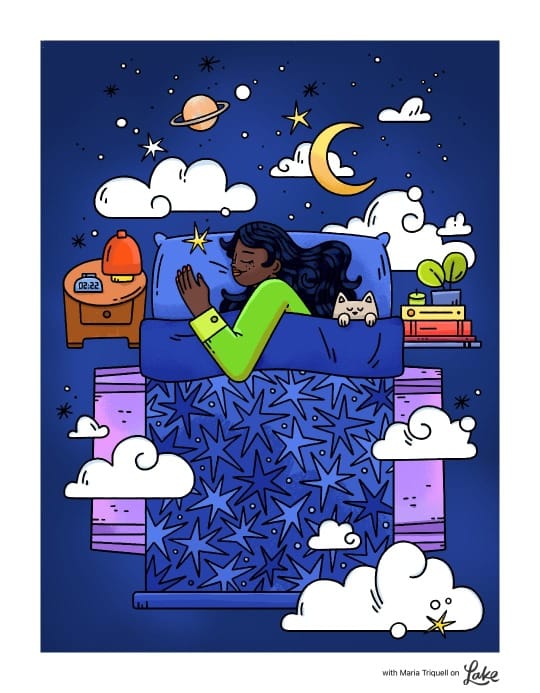
These days, coloring is something I genuinely look forward to at night. I turn on dark mode, switch off notifications, open Lake, and color. No agenda, no timer, no pressure to finish anything. Just coloring.
I noticed the difference almost immediately. My breathing slowed. My thoughts got quieter. My eyes felt heavier in that soft, welcome way, the way they're supposed to feel before sleep. Sometimes I finish a piece, sometimes I don't. It doesn't matter either way. The point isn't the output, it's the process. Coloring creates just enough gentle focus to occupy the restless part of my brain without giving it anything to escalate.
What our community taught me
And I’m not the only one. As a cofounder of Lake, I’ve heard this first-hand from Lake users. One App Store reviewer wrote: "I turn on the music or relaxing nature sounds and begin coloring...no pencils rolling around, no struggle to keep a book open and no need for special lighting. It's the perfect way to end my day and prepare to relax for sleep." Another shared simply: "I really love this app, it’s so calming before bed each night and it’s so much fun to play around with colors and texture."
Reading things like this never gets old. There's something genuinely moving about knowing that a thing you built has found its way into someone's most private, quiet moments - the end of their day, right before sleep. That's not a use case we designed for on a whiteboard. It emerged naturally, from real people finding their own way to wind down.
What these stories have in common is the shift from passive consumption to quiet, creative engagement. You're not absorbing information. You're not reacting to anything. You're just making something small and beautiful, for yourself, at the end of the day.
A few things that made the difference for me
If you want to try this yourself, a few small adjustments helped me turn it into a real habit rather than a passing experiment:
- Dark mode is non-negotiable. A dark interface at night feels completely different - softer, more like candlelight than a spotlight.
- Notifications off before you start. Even if you don't look at them, the possibility of a notification is enough to keep part of your brain on alert. Removing that option entirely changes the quality of the experience.
- Keep it pressure-free. Don't pick a complex, detailed page when you're tired. Pick something loose and satisfying. The goal is to let your mind wander gently, not to produce something impressive.
- Give it ten minutes before judging it. The first few times I colored at night, I felt a little restless at the start. It took a few sessions to actually settle into it. If you try once and it doesn't immediately knock you out, give it a week.
If your mind is noisy at night
Sleep culture has made us think the solution is always something to take, something to play, or something to block out. But sometimes what works is something to gently do. Something that gives your mind just enough to hold onto while the rest of you catches up.
So if you're lying there with a buzzing brain and a phone in your hand, maybe try putting down the scroll and picking up some color instead. You might be surprised how peaceful it feels - and how quickly the quiet follows.